
The CIO Job Description Problem
Most CIO job descriptions are still written for 2020. The role has moved on. Companies that do not update the mandate keep wondering why their AI programs stall.

Open a job board, search for “Chief Information Officer,” and read the first ten postings. Most of them lead with infrastructure modernization, vendor management, and IT operations. That is real work. It is also work that describes the CIO of 2020.
The actual job has moved on. I am not sure the job description has.
The gap between title and mandate
CIO.com’s 2025 State of the CIO survey of over 900 IT leaders found 41% now describe their role as primarily strategic, up from 35% the year before. More than half expect that to deepen over the next three to five years. Gartner’s 2026 CIO and Technology Executive Survey goes further. 94% of CIOs expect major changes to their plans and outcomes inside of 24 months.
Read how most companies actually write the CIO job description, though, and you would think the role was still mostly about keeping the lights on.
Riviera Partners, one of the more respected executive search firms in technology leadership, called it out in their 2026 analysis. Organizations are running into “significant misalignment” in three places. Legacy job descriptions that emphasize systems rather than outcomes. Org structures built for centralized IT instead of intelligent operations. CIOs who are told to “own AI” without the authority to actually change the operating model.
That last one is the real tell. If you are asking a CIO to own AI without giving them the leverage to change how the business works, you are not hiring a CIO. You are hiring a scapegoat.
What the modern CIO actually does
The role sits at an intersection that did not exist a decade ago. Enterprise AI and data strategy. Connecting technology investment to measurable business outcomes. Governing responsible AI, which went from optional to essential in about eighteen months. Translating between the board and the engineering team, fluent in both financial outcomes and technical architecture.
CIO.com put it well. The CIO in 2026 “will be about influencing, leading, and governing, as opposed to technology selector, integrator, configurator, and customizer.” Gartner frames it as the board governing strategy while the CIO governs intelligence.
That is a different skill set than the one most job descriptions are screening for.
Consider the AI dimension on its own. Enterprise AI spending is up more than 35% year over year. 87% of organizations plan to increase their generative AI budgets. 64% plan to deploy agentic AI inside 24 months. The CIO is increasingly the person accountable for whether any of that produces returns or just produces demos.
The track record so far is not good. MIT’s 2025 research found that 95% of generative AI pilots fail to scale to production. RAND Corporation’s analysis puts it at 80% of AI projects failing to deliver intended business value. 42% of companies abandoned at least one AI initiative in 2025, with average sunk costs of $7.2 million per abandoned effort.
The failure almost never comes from the model. It comes from data readiness, workflow integration, and the absence of a defined business outcome before anyone starts building. Which is exactly the kind of problem a strategically oriented CIO is supposed to prevent, assuming the organization actually hired for that.
The title fragmentation problem
Part of what is muddying all of this is the proliferation of C-suite technology titles. CIO, CTO, CDO, and now CAIO (Chief AI Officer), all orbiting overlapping territory. An IBM study from early 2025 found that 26% of organizations now have a dedicated Chief AI Officer, up from 11% two years earlier. Among FTSE 100 companies, nearly 48% have a CAIO or equivalent, and 67% of those appointments were made in the last two years.
The instinct to create a new title for every emerging priority is understandable. It also tends to make the underlying problem worse. When AI governance sits with the CAIO, data strategy sits with the CDO, and infrastructure sits with the CIO, you end up with coordination costs where you wanted coherent strategy.
The 2026 trend that Riviera Partners and others are tracking is actually a consolidation. The CDO and CAIO responsibilities are folding back under a redefined CIO who can connect all three. That only works if the organization sees the redefinition in the first place.
The hiring consequence
When a company writes a CIO job description that leads with operational excellence and IT governance, it attracts a very specific kind of candidate. Experienced operators. Solid leaders. People who can keep enterprise systems running smoothly, which is not a trivial thing.
What that posting does not attract is the person who can sit in a board meeting and articulate why a particular AI capability creates competitive advantage, then walk into an architecture review twenty minutes later and push back on how it is being built. Someone who thinks in terms of business sequencing, not just technology roadmaps. Someone who can look at a portfolio of AI experiments and make the hard calls about which ones scale and which ones get killed.
That candidate pool is smaller than most organizations think. The companies that figured this out early are already two years into building their bench.
Robert Half’s 2026 hiring data shows 61% of technology leaders expect to increase permanent headcount this year. Only 7% say they currently have the skills required to complete their top projects, and 65% report their teams need additional training. The gap between what organizations need and what they are hiring for is not just a CIO problem. It cascades through the whole technology organization.
A better starting point
If I were advising a board on what to put in a CIO job description today, I would not start with infrastructure or vendor management. I would start by asking what the enterprise AI and data strategy actually is, and who owns it. Not “who manages the AI tools” but who decides which capabilities get built, which get bought, how they are governed, and how their value gets measured.
The second question is who translates between the business and the technology organization. Not a liaison. A leader. Someone who understands architecture deeply enough to evaluate tradeoffs but thinks in terms of competitive advantage and business outcomes.
The third is accountability for turning AI investment into measurable value. Right now, with 95% of pilots stalling and $7.2 million in average sunk costs per abandoned initiative, someone needs to own the outcome, not just the experiment.
The CIO title can carry all of that. It has the weight and the history. What has to catch up is the mandate underneath it.
The window is open
Gartner expects 2026 to be the year organizations move from AI experimentation to demanding measurable ROI. CIO hiring is heating up specifically for leaders with strategic AI capabilities. The organizations that rewrite the mandate now, centering it on AI strategy, data governance, and cross-functional transformation, are the ones likely to see returns on their technology spend.
The organizations that keep hiring for the 2020 version of the role will keep sitting through quarterly reviews wondering why their AI programs stall at the pilot stage.
Sources
- State of the CIO, 2025: CIOs Set the AI Agenda — CIO.com
- The CIO Agenda 2026: Master Agility, Risk and Tenacity — Gartner
- Why the CIO Will Be the Most Important Role, or Hire, of 2026 — Riviera Partners
- 4 Ways the CIO Role Will Expand in 2026 — CIO.com
- 7 Changes to the CIO Role in 2026 — CIO.com
- CIO Hiring to Heat Up in 2026, Especially for Strategic AI Leaders — CIO.com
- MIT Report: 95% of Generative AI Pilots at Companies Are Failing — Fortune / MIT
- AI Project Failure Rate 2026 — Pertama Partners / RAND
- CAIOs Are Stepping Out from the CIO’s Shadow — CIO.com
- Do You Need a CAIO? The Rise of the Chief AI Officer — The New Stack / IBM
- 2026 Tech Hiring Trends — National CIO Review
- Employment and Hiring Trends in 2026 — Robert Half
- CIO vs. CTO vs. CDO: Who Should Own Intelligence Now? — Riviera Partners
Related Articles

The Rise of the Citizen Developer
AI tools like Claude Code and Figma Make are putting real building power into the hands of non-developers. The question is not whether to embrace it — it is how to govern it.
The Certification I Did Not Think I Needed
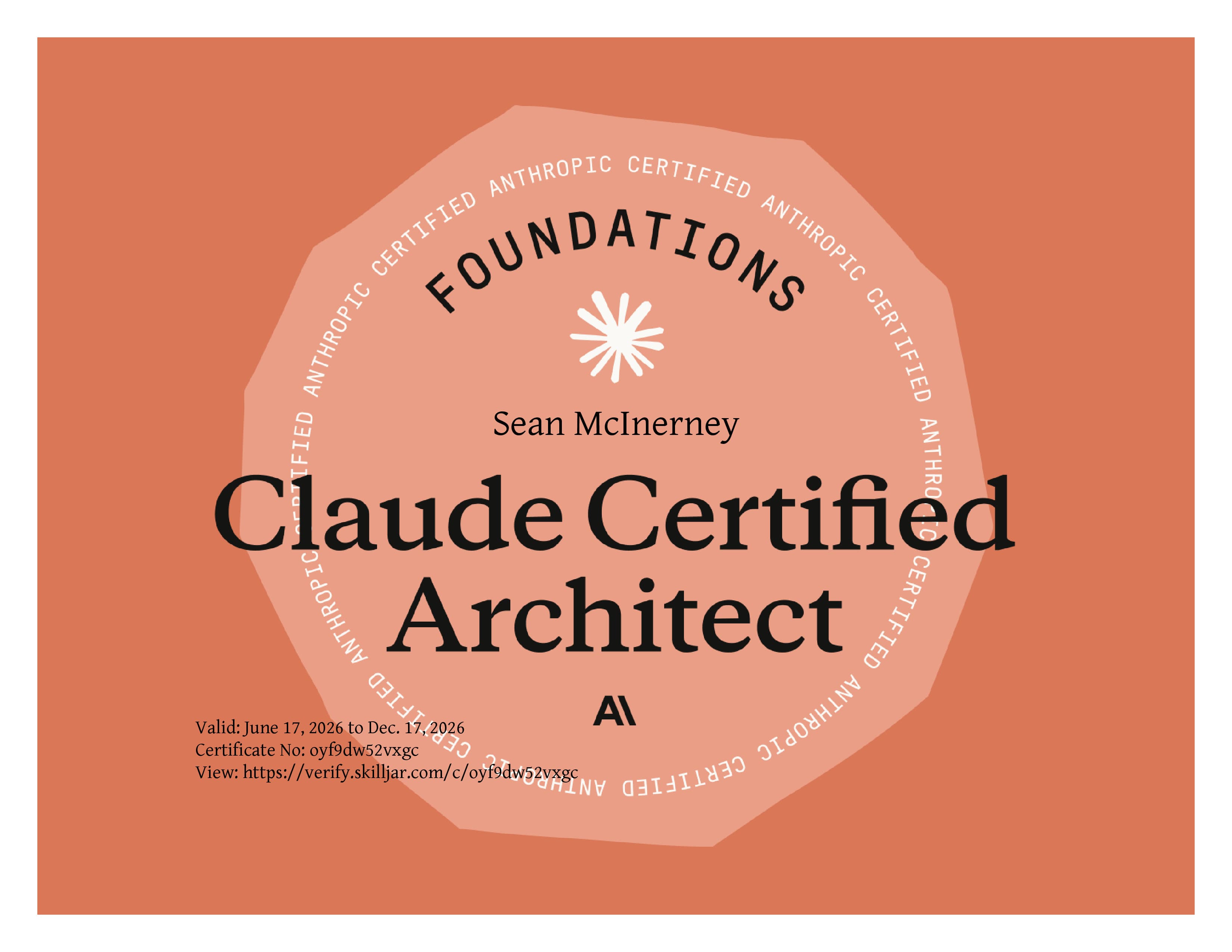
I had not sat a real technical certification exam in years. Earning the Claude Certified Architect credential reminded me that understanding how AI is built is what clients actually pay for.

The Website Did Not Die. Its Job Changed.
Adweek says brands are ditching websites for AI-native experiences. Adoption data tells a different story. Both describe the same shift — the website's job is splitting in two.
Ready to discuss your project?
We would love to hear about what you are working on.
Let's Talk