
The Certification I Did Not Think I Needed
I had not sat a real technical certification exam in years. Earning the Claude Certified Architect credential reminded me that understanding how AI is built is what clients actually pay for.
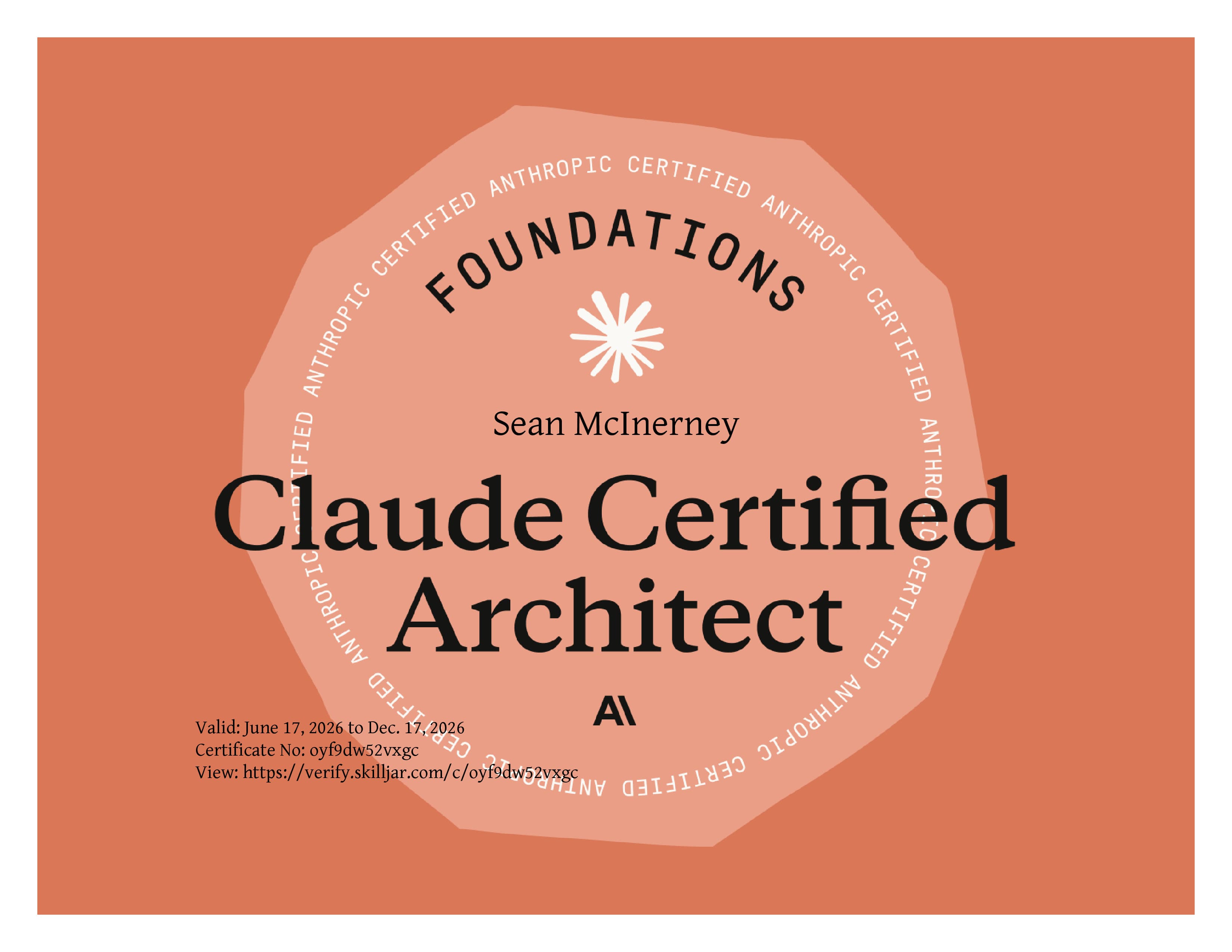
It had been a long time since I had sat down for a real technical certification exam, and the old nerves came back the moment I signed in. I have been doing this since 1999, and that feeling still does not fully go away. I have made my peace with it. I think it is even useful.
This week I passed the Claude Certified Architect — Foundations exam. A month ago I would have told you I did not need it. I have spent most of the last two years building enterprise AI systems with my own hands rather than advising on them from a slide deck, and I was comfortable. So the question worth answering is why I sat the exam at all, and why I walked away from it more energized than I have been in a while.
Student, not spectator
This wave of AI is moving faster than anything I have watched in more than twenty-five years of digital work. Once you have a little grey hair, the comfortable move is to narrate it from the sidelines. Have opinions. Be the person in the room who has seen a few cycles come and go.
I would rather still be learning it with my hands.
An exam is a specific kind of test. It does not care how fluently you talk about the subject or how certain you sound. It asks whether you actually know the material, under conditions you do not get to set. Earning the credential was a way to put what I believe I know on the line and find out whether it held.
Why the foundations matter more than the demos
Something gets obvious once you are building instead of presenting. There are a lot of flavors of AI out there, and they do not behave the same way.
We tend to talk about “AI” as if it were one material with fixed properties. It is not. A retrieval system and a fine-tuned model solve different problems. A single prompt and a set of coordinated agents fail in different ways. A model that reasons its way through a problem and one that pattern-matches to a confident wrong answer can look identical on stage and behave nothing alike in production. Telling them apart is most of the work.
Understanding the architecture underneath, how these systems actually work and where they break, is what separates a demo that wins a room from something a client can put in front of their own customers.
The numbers make the case better than I can. MIT’s 2025 research found that 95% of generative AI pilots never reach production. RAND put roughly 80% of AI projects in the failure column. The model is almost never the reason. The reason is usually a capable model wired into the wrong workflow, pointed at the wrong data, with no one having decided up front what success was supposed to look like.
What clients are actually paying for
At Lakehouse Digital the work has changed shape. The request is rarely “add some AI to our product.” It is closer to “tell us honestly which of these approaches survives contact with our customers, our data, and our budget.”
Mostly they are paying for judgment. Enthusiasm about AI is cheap and everywhere. What is scarce is someone who can look at a problem and say, with reasons, this part wants an agent, this part wants retrieval, this part does not need a model at all, and this one will quietly run up a token bill for no real gain.
They are paying for the distance between a demo and a system. A demo has to work once, on a good day, with a friendly question. A real system has to hold up on an ordinary Tuesday, with a confused or difficult user, inside whatever limits the business has to live with. Closing that distance is the actual deliverable.
And they are paying to trust what ships. When a client puts an AI feature in front of their own customers, it is their name on it, not ours. That trust gets built into the architecture long before anyone sees a screen, in the calls about what the system may do on its own, where it should hand off to a person, and how it behaves when it fails.
I keep coming back to the same point. None of that comes from talking about AI. It comes from knowing the foundations well enough to get the unglamorous decisions right, over and over.
Staying a student of what you think you already know
So even though I would have said I was already comfortable building with Claude, there was something genuinely satisfying about earning the credential to go with it. Not because a certificate changes what I can do. Because being tested confirmed that the instincts I have built up in the work survive being written down and graded.
It was a good reminder to keep studying the things you assume you have already figured out. The moment you decide a field is settled tends to be the moment it moves under you, and AI is moving quickly enough right now that proving it to yourself is the only honest position.
Where this leaves us
I passed, and I am more energized than I have been in a long time. Mostly about the people who want to build this carefully instead of loudly.
That is what Lakehouse Digital does. Less an opinion about AI, more work that holds when a real client leans their full weight on it. In practice that is a few concrete things. We integrate AI into the workflows a business already runs, instead of bolting a chatbot onto the side and calling it transformation. We build the digital experiences around that work, online and in the room, so the technology reaches the people it is meant to serve. And we stay close enough to the architecture to make the honest calls: which approach fits the problem, where a model earns its keep and where it quietly does not, and how the whole thing behaves when a real user leans on it.
Doing it right is mostly discipline, not magic. We decide the outcome before building anything. We match the architecture to the problem instead of to the hype. We put the guardrails in on purpose. We check whether the work actually moved the number it was meant to move. None of that is glamorous, and all of it is the difference between a pilot that stalls and a system a client can stand behind.
A foundations credential is a small thing next to that work. It is also exactly the kind of small thing the serious people keep bothering to do. The nerves at the sign-in screen turned out to be worth something. They meant I still cared whether I actually knew the answer, and that is the instinct we bring to every engagement we take on.
Sources
- Claude Certified Architect — Foundations (credential verification) — Anthropic Education
- MIT Report: 95% of Generative AI Pilots at Companies Are Failing — Fortune / MIT
- AI Project Failure Rate 2026 — Pertama Partners / RAND
Related Articles
The Website Did Not Die. Its Job Changed.
Adweek says brands are ditching websites for AI-native experiences. Adoption data tells a different story. Both describe the same shift — the website's job is splitting in two.

The CIO Job Description Problem
Most CIO job descriptions are still written for 2020. The role has moved on. Companies that do not update the mandate keep wondering why their AI programs stall.

Agentic Workflows: It Is Not Just a Technology Problem
Everyone is talking about AI agents. Few discuss what it takes to run agentic workflows inside a real organization — the people, process, and data foundations that determine success or failure.
Ready to discuss your project?
We would love to hear about what you are working on.
Let's Talk