
McDonald's Touch Screen Ordering: Self-Order Kiosks and Digital Menu Boards
Self-order kiosks, digital menu boards, and a unified ordering platform that cut average order time by 30% and lifted average order value by 22% across 3,000+ restaurants.
Results
- Reduced average order time by 30% through self-service kiosks
- Increased average order value by 22% with suggestive upsell UI
- Rolled out to 3,000+ locations in the first year
Context
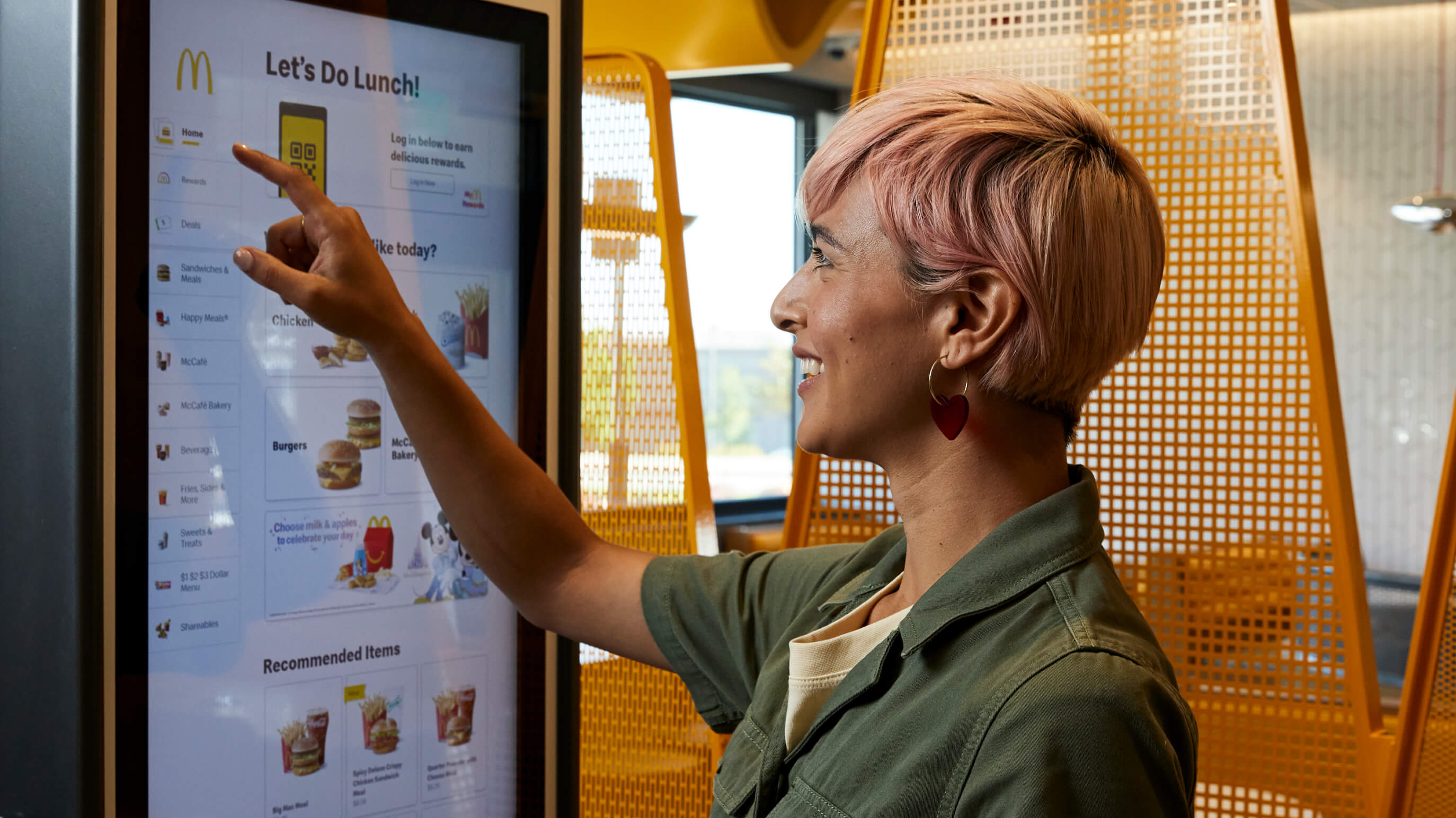
McDonald’s self-order kiosks and digital menu boards cut the average order time by 30 percent against counter ordering, lifted average order value by 22 percent, and reached more than 3,000 restaurants in the first year. While leading technology at Huge, we partnered with McDonald’s on that programme, and the brief was to reimagine what the in-restaurant experience could look like in a world where digital and physical touchpoints need to work as one. The quick-service restaurant industry was at an inflection point: mobile ordering was gaining traction, but the in-store experience had barely changed in decades. McDonald’s recognized that the restaurant itself needed to become a digitally-enabled environment — not just a place where you happened to pick up food you ordered on your phone.
The engagement spanned kiosk interaction design, digital menu board content strategy, and a unified ordering platform that tied everything together. Our mandate was clear: make the restaurant smarter without making it feel colder.
Challenge
The core challenge was convergence. McDonald’s had separate systems for counter ordering, drive-through, mobile, and delivery — each with its own interface logic, pricing engine, and user experience. Customers moving between channels encountered inconsistent menus, different promotional offers, and disconnected loyalty tracking. For crew members, the operational complexity meant longer training cycles and more errors during peak hours.
Beyond the technology fragmentation, there was a human experience problem. Self-service kiosks were perceived as impersonal by many customers, and earlier pilot programs had seen mixed adoption rates. We needed to design kiosk interactions that felt intuitive and welcoming rather than transactional — a significant UX challenge when the average order needs to be completed in under 90 seconds.
Approach
We started with extensive in-restaurant observation across twelve markets, watching how customers actually moved through the space and made decisions. This ethnographic research revealed that the ordering moment was just one piece of a larger journey that included wayfinding, menu discovery, customization, payment, and pickup. Each of those moments had friction points that compounded.
Our design approach centered on three principles: simplicity first, progressive disclosure, and ambient intelligence. The kiosk interface led with the most popular items and meal combinations, letting customers place a standard order in three taps. Customization options were available but never forced. The suggestive upsell system used time-of-day context and order composition to make relevant suggestions rather than generic prompts — breakfast items in the morning, dessert additions after a full meal was assembled.
For the digital menu boards, we developed a dynamic content system that could shift layouts based on daypart, weather, and local inventory. This meant the boards were always showing items that were both appealing in context and available to serve. The visual design language maintained McDonald’s brand warmth while introducing a cleaner, more modern information hierarchy that made scanning the menu faster.
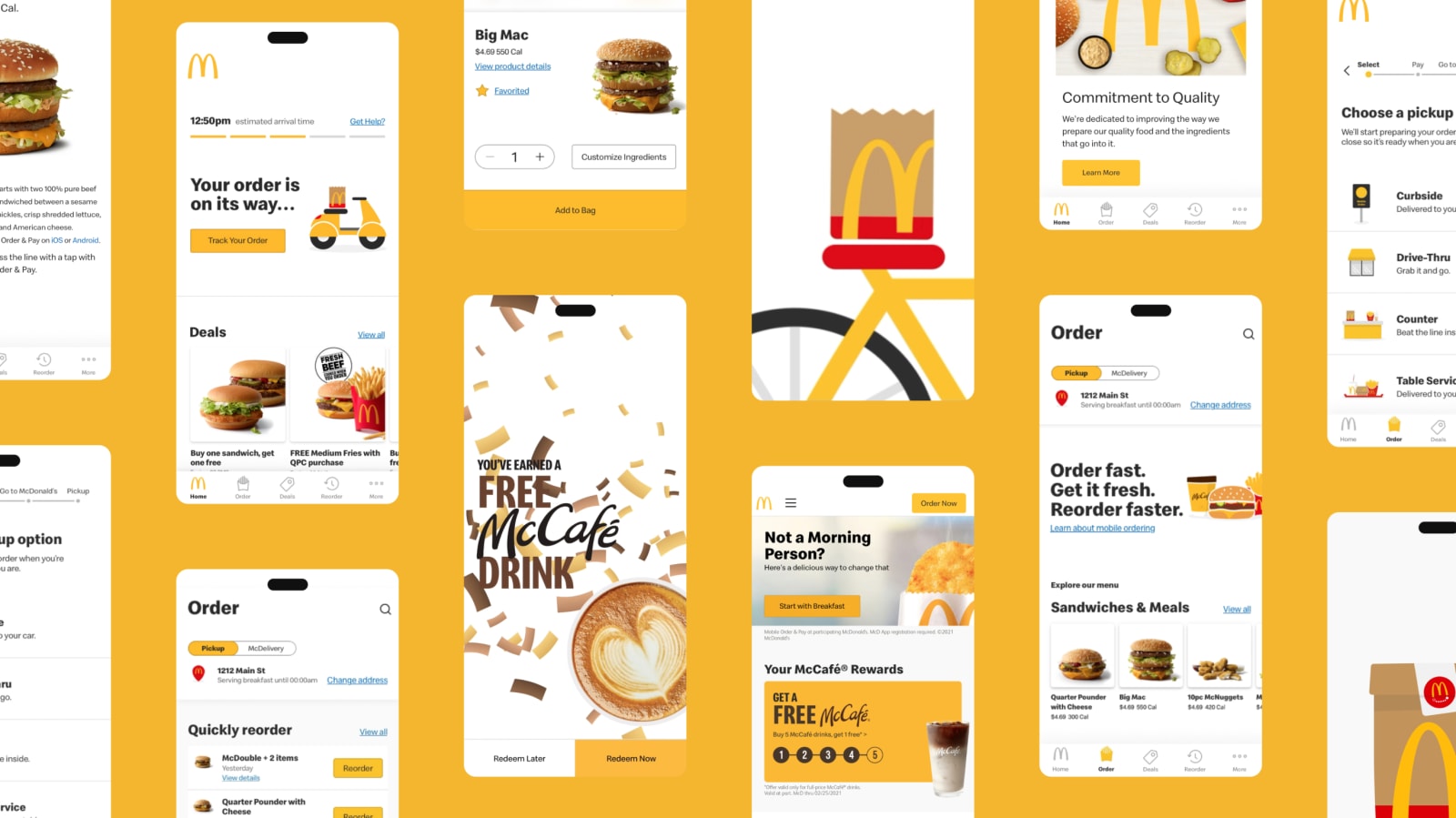
The unified ordering platform underneath brought all channels onto a single service layer. Whether a customer ordered at a kiosk, on their phone, or at the counter, the same engine processed the order with consistent pricing, promotions, and loyalty point accrual. This architectural unification was the invisible foundation that made the visible experience improvements possible.
Results
The impact became clear within the first six months of the pilot rollout. Self-service kiosks reduced the average order time by 30 percent compared to counter ordering, and the contextual upsell system drove a 22 percent increase in average order value — significantly outperforming the static suggestive selling that crew members had been trained to do. Customer satisfaction scores in pilot locations rose measurably, with particular improvement in the “speed of service” and “ease of ordering” dimensions.
The program rolled out to over 3,000 locations in its first year, with the unified platform enabling rapid deployment once the initial integration work was complete. Perhaps most importantly, the approach proved that digital transformation in physical spaces does not have to sacrifice warmth for efficiency. The restaurants felt more modern and more welcoming at the same time — a balance that became a reference point for McDonald’s global experience strategy moving forward.
Ready to discuss your project?
We would love to hear about what you are working on.
Let's Talk